What is Forex?
What the forex market is, how $9.6 trillion changes hands every day, who trades it, and why it is the most accessible financial market for retail traders.
- Lesson 1 of 30
- 3 min read
- Beginner
- Updated

Key takeaways
- Forex (FX) is the global market for exchanging one currency for another, and the largest financial market in the world.
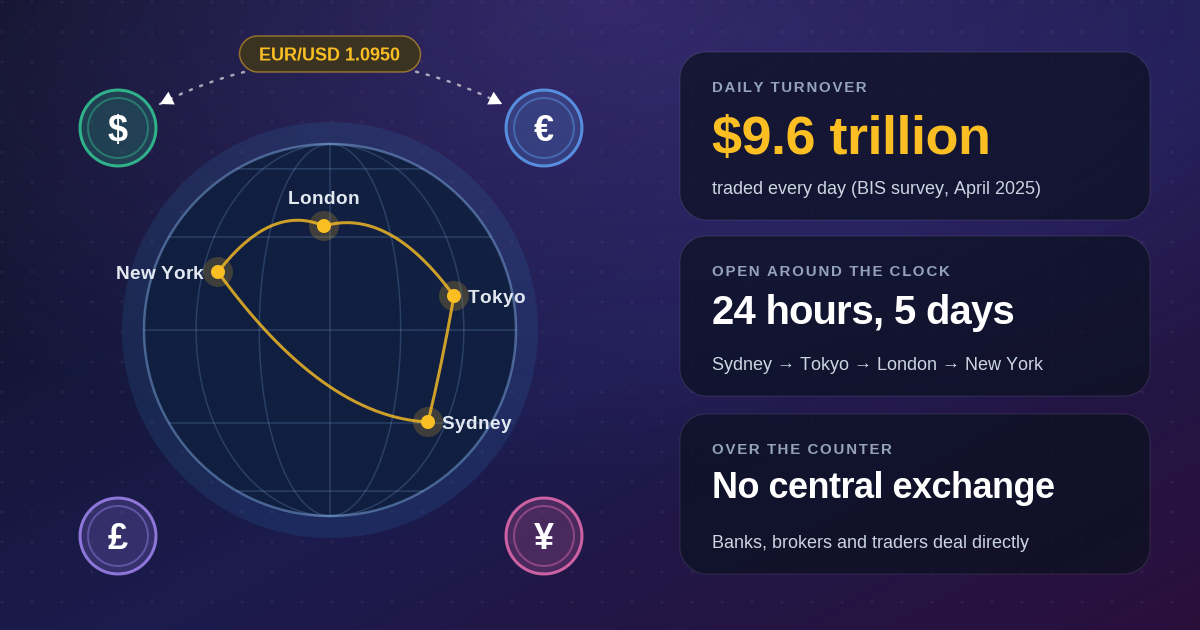
- About $9.6 trillion trades every day, according to the Bank for International Settlements’ survey of April 2025.
- There is no central exchange: banks, brokers and traders deal over the counter, 24 hours a day, five days a week.
- Currencies always trade in pairs, and leverage magnifies gains and losses alike, so risk management comes first.
Welcome to the Foreign Exchange Market 🌎💱
Forex (often shortened to FX) is where the world swaps one currency for another-whether it’s Apple paying suppliers in China, a hedge fund betting on euro strength, or you booking a Dubai holiday. With $9.6 trillion changing hands every day (BIS survey, April 2025), it’s the biggest financial playground on earth.
24 / 5 Access
Trades roll from Sydney to New York with only a weekend power-nap.
$9.6 Tn Daily
That’s more than global stock markets combined.
180+ Currencies
From major pairs like EUR/USD to exotic combos such as USD/TRY.
Forex in a Nutshell
- Decentralised OTC market – no single exchange, trades flow through banks & electronic networks.
- Currencies trade in pairs; price shows one unit of the base currency measured in the quote currency (e.g.
GBP/USD = 1.30). - Liquidity is king – tight spreads on majors, wider on exotic pairs.
- Leverage lets you control large positions with a small deposit (but amplifies risk!).
Why Trade Forex?
• Accessibility: low minimum deposits, free demo accounts.
• Go long or short: profit in rising and falling markets.
• Diversification: hedge against stock/crypto exposure.
• Liquidity: easy to enter & exit positions-even big ones.
But Watch the Pitfalls
• Over-leveraging turns small moves into giant swings.
• News events can spike spreads in milliseconds.
• 24-hour access tempts traders to over-trade.
Spoiler: risk management is your new best friend.
A Lightning History ⚡
-
1971: Bretton Woods collapses. Currencies start floating freely.
-
1990s: Internet + retail broker boom opens FX to the public.
-
Today: AI, algos & smartphone apps let anyone trade from a beach (Wi-Fi permitting 🏝️).
“The market is a device for transferring money from the impatient to the patient.” - Warren Buffett
Frequently asked questions
What is forex trading in simple terms?
Forex trading is buying one currency while selling another, hoping the exchange rate moves in your favour. If you buy EUR/USD and the euro strengthens against the dollar, the position gains value; if the euro weakens, it loses.
How big is the forex market?
It is the largest financial market in the world. The Bank for International Settlements measured average turnover at $9.6 trillion a day in April 2025, up from $7.5 trillion in 2022.
When is the forex market open?
Forex trades 24 hours a day, five days a week, from the Sydney open on Sunday evening to the New York close on Friday evening (London time). Activity passes from Sydney to Tokyo, London and New York, and is busiest when London and New York overlap.
Is forex trading risky?
Yes. Prices can move quickly, and leverage means a small move can produce a large gain or loss relative to your deposit. Brokers’ own risk warnings show that most retail accounts trading leveraged CFDs lose money, which is why sizing every trade from a stop-loss matters more than any strategy.


Put it into practice with Tracom's trade journal, risk calculator and signal record. Free to download.