Market Participants & Sessions
Who moves forex, from central banks and Tier-1 banks to hedge funds and retail traders, and when the Sydney, Tokyo, London and New York sessions trade.
- Lesson 6 of 30
- 3 min read
- Beginner
- Updated


Key takeaways
- Tier-1 banks quote prices to the rest of the market and handle a large share of daily volume.
- Central banks set interest rates and occasionally intervene; hedge funds, asset managers and corporations trade for profit or to hedge.
- Retail traders are a small share of volume but trade the same pairs through brokers and ECNs.
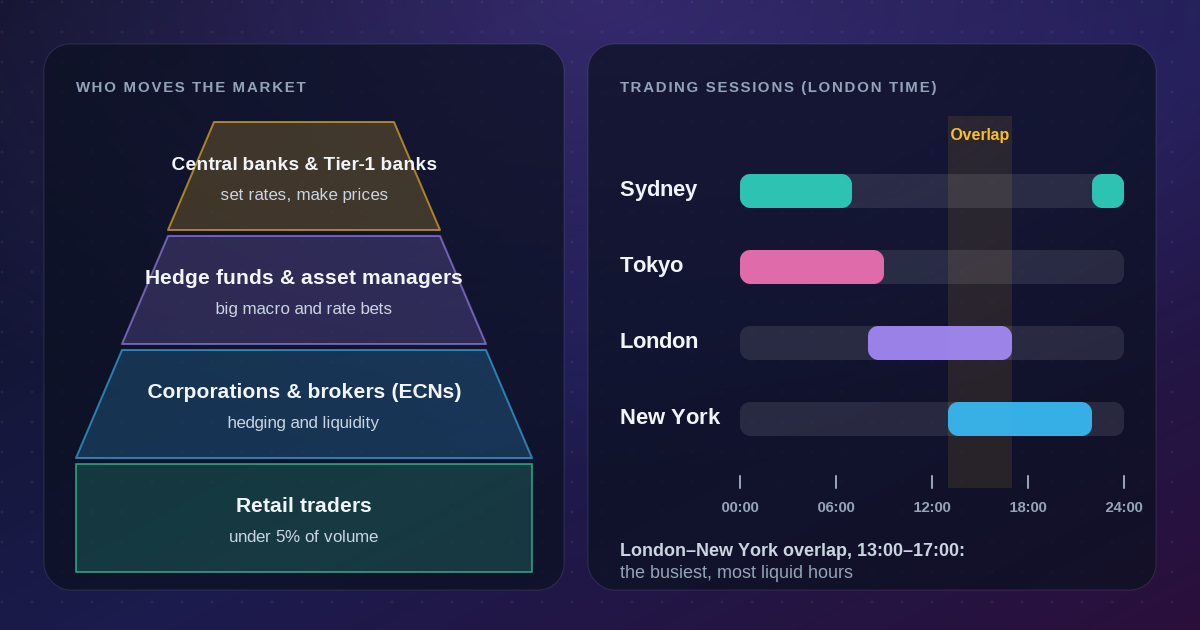
- The market follows the sun from Sydney to Tokyo, London and New York; the London–New York overlap, 13:00–17:00 London time, is the most liquid window.
Who Actually Moves the Forex Market?
The FX market is like a huge global cocktail party 🌏🍸-banks, funds, businesses and regular folk all mingle and swap currencies 24 hours a day. Knowing who’s who helps you understand why price sometimes drifts politely…and other times sprints like it just spotted free pizza.
Tier-1 Banks (Liquidity Providers)
Names like JPMorgan, Citi, Deutsche, and UBS quote two-way prices to everyone else. They’re the market’s bartenders-always ready with a bid/ask “drink”.
- Account for ± 40 % of daily volume
- Often trade on behalf of clients
- Also run proprietary desks for their own profit
Central Banks
The policy-makers (Fed, ECB, BoJ…) set interest rates and occasionally intervene directly. When they hint at a hike, traders perk up faster than after a triple espresso.
Hedge Funds & Asset Managers
Macro funds (think Bridgewater, Brevan Howard) bet billions on rate differentials or geopolitical shifts. Meanwhile, asset managers rebalance currency exposure for pension funds.
Multinational Corporations
Apple hedging iPhone sales in Europe? That’s a corporate flow. These trades aren’t speculative- they’re about locking in costs and revenues.
Retail Brokers & ECNs
Platforms like OANDA, IC Markets or Pepperstone package bank liquidity and serve it to retail traders via MT4/5 or cTrader.
Retail Traders (👋 that’s us)
We’re the smallest slice of the pie (< 5 % volume) but technology lets us ride the same waves as the giants-just with tighter risk reins.
Global Trading Sessions ⏰
The market follows the sun. Here’s the usual rhythm (GMT / London time):
| Session | Opens | Closes | Highlights |
|---|---|---|---|
| Sydney | 22:00 | 07:00 | AUD & NZD news drops |
| Tokyo | 00:00 | 09:00 | JPY pairs wake up |
| London | 08:00 | 17:00 | Largest liquidity window |
| New York | 13:00 | 22:00 | USD data, Wall St moves |
Notice the overlaps London ↔ New York (13:00–17:00) and Sydney ↔ Tokyo (00:00–02:00)-that’s when spreads tighten and volatility often pops. Plan your trading hours accordingly!
Trader tip: keep an eye on the economic calendar-when a central-bank speech lines up with a high-liquidity session, fireworks are likely. 🎆
Frequently asked questions
What is the best time to trade forex?
For most pairs the busiest, most liquid period is the London–New York overlap, roughly 13:00 to 17:00 London time, when spreads are tight and moves are strongest. Yen and Australian dollar pairs are also active in the Tokyo and Sydney sessions.
Who are the biggest players in the forex market?
Large dealing banks such as JPMorgan, UBS, Citi and Deutsche Bank make prices and handle a large share of volume. Central banks, hedge funds, asset managers and multinational corporations follow, with retail traders a small fraction of the total.
What are the four forex trading sessions?
Sydney (about 22:00–07:00 London time), Tokyo (00:00–09:00), London (08:00–17:00) and New York (13:00–22:00). The exact hours shift by an hour when the clocks change for daylight saving.


Put it into practice with Tracom's trade journal, risk calculator and signal record. Free to download.