Currency Pairs, Majors & Minors
Major, minor and exotic currency pairs explained: base and quote currencies, how spreads differ between them, and which pairs suit beginners best.
- Lesson 2 of 30
- 3 min read
- Beginner
- Updated


Key takeaways
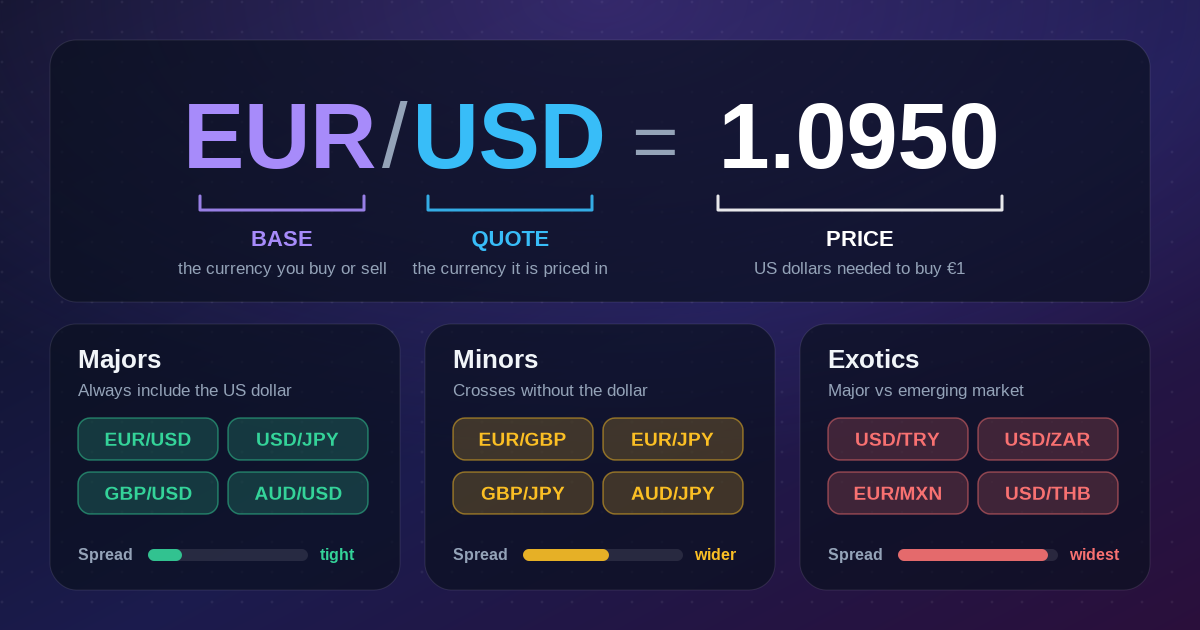
- A pair is written BASE/QUOTE, and its price is how much of the quote currency buys one unit of the base.
- Majors all include the US dollar, such as EUR/USD, USD/JPY and GBP/USD, and have the deepest liquidity and tightest spreads.
- Minors, or crosses, pair two major currencies without the dollar; exotics pair a major with an emerging-market currency and cost more to trade.
- Buying a pair means buying the base and selling the quote: buying USD/JPY is a bet on the dollar rising against the yen.
Decoding Currency Pairs - Majors, Minors & Exotics
In Forex you never trade a single currency in isolation-you’re always swapping one for another. Think of it like ordering a coffee in Europe and paying in US Dollars: the café must convert USD → EUR, and that rate is a currency pair!
Anatomy of a Pair
Every pair is written BASE/QUOTE. The price tells you how many units of the quote currency
you need to buy one unit of the base.
EUR/USD = 1.0950 → It costs $1.0950 (quote) to buy €1 (base)
If that price rises to 1.1000, the euro strengthened vs the dollar (or the dollar weakened vs the euro).
Majors 🌍
Include the U.S. Dollar and boast huge liquidity & razor-thin spreads.
- EUR/USD (Euro-Dollar)
- GBP/USD (Cable)
- USD/JPY (Dollar-Yen)
- USD/CHF (Swissy)
- AUD/USD · NZD/USD · USD/CAD
Minors (Crosses) 🔄
Pairs without the USD. Liquidity is still decent, spreads a tad wider.
- EUR/GBP · EUR/JPY · GBP/JPY
- AUD/JPY · CHF/JPY
- EUR/AUD · GBP/CAD …
Exotics 🐅
Major currency vs an emerging-market one. Spreads can be chunky & volatility spicy-handle with care!
- USD/TRY (Turkish Lira)
- USD/ZAR (South African Rand)
- EUR/MXN · USD/THB …
Most-Traded Pairs by Volume
Shares of global FX turnover from the BIS Triennial Survey of April 2022, the latest with a full breakdown by pair (rounded). In the April 2025 survey, USD/CNY grew to 8.1%.
| Pair | Nickname | Share of Daily Volume |
|---|---|---|
| EUR/USD | Fiber | ~23 % |
| USD/JPY | Gopher | ~14 % |
| GBP/USD | Cable | ~10 % |
| USD/CNY | Dollar-Yuan | ~7 % |
| USD/CAD | Loonie | ~6 % |
| AUD/USD | Aussie | ~5 % |
Liquidity peaks during the London–New York overlap, so majors often have spreads as low as 0.1 pip on ECN accounts. Crosses & exotics widen outside their home sessions.
Trader tip: base/quote order matters! If you think the Japanese yen will weaken vs the dollar,
you’d buy USD/JPY. Flipping it to JPY/USD (rarely quoted) would be a completely different trade.
Frequently asked questions
What are the major currency pairs?
The majors are the most traded pairs that include the US dollar: EUR/USD, USD/JPY, GBP/USD, USD/CHF, AUD/USD, USD/CAD and NZD/USD. EUR/USD is the most traded pair of all.
Which currency pair is best for beginners?
Most beginners start with EUR/USD or another major, because spreads are tight, liquidity is deep and there is plenty of analysis and news coverage. Exotic pairs move erratically and cost more to trade.
What is the difference between the base and the quote currency?
The base is the first currency in the pair and the quote is the second. EUR/USD at 1.0950 means one euro (the base) costs 1.0950 US dollars (the quote). When the price rises, the base has strengthened against the quote.


Put it into practice with Tracom's trade journal, risk calculator and signal record. Free to download.