Economic Indicators & News
The economic releases that move forex, including non-farm payrolls, CPI, GDP, PMI and central bank decisions, and a step-by-step game plan for trading the news safely.
- Lesson 25 of 30
- 3 min read
- Advanced
- Updated


Key takeaways
- The biggest market movers are non-farm payrolls, inflation (CPI), central bank rate decisions, GDP and PMI surveys.
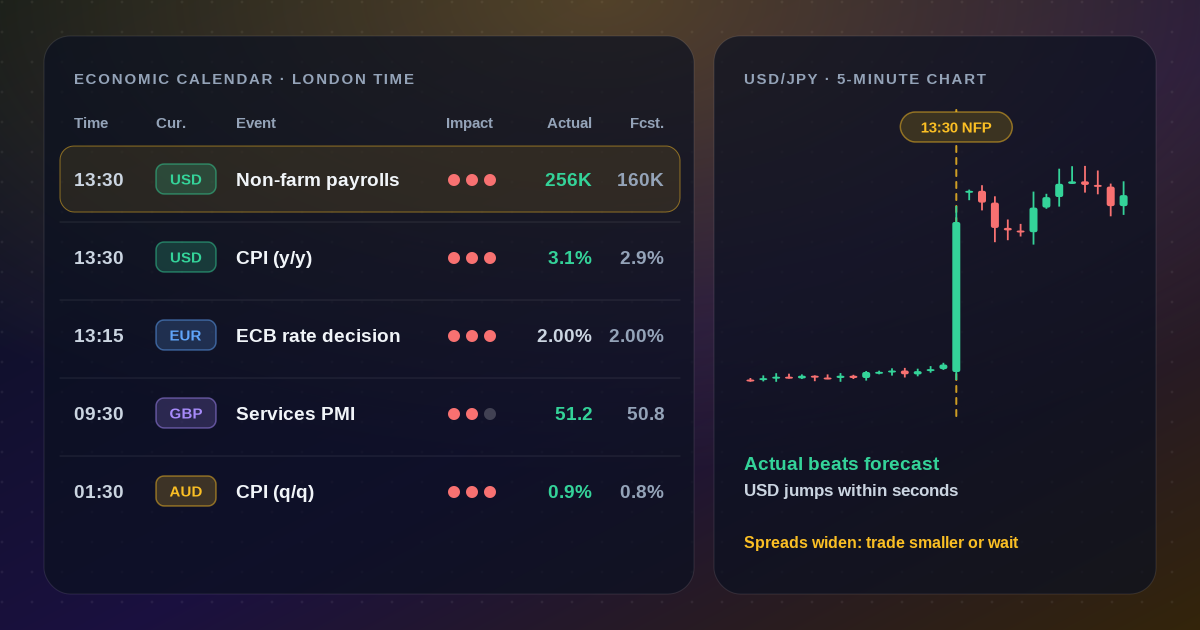
- Prices react to the surprise, the gap between the actual figure and the consensus forecast, not to the number alone.
- US payrolls are usually released on the first Friday of the month at 13:30 London time, and US CPI around mid-month.
- Around big releases spreads widen and slippage rises: reduce size, keep stops clear, or wait 5–15 minutes for price to settle.
Economic Indicators & News Trading
Every week fresh data drops into the market’s inbox 📥. A blow-out jobs print or a “hot” inflation reading can send currencies sprinting. Let’s decode the numbers that matter-and how traders ride that news wave.
Growth 📊
GDP, PMI, Retail Sales tell us how quickly an economy is expanding. Upside surprises fuel rate-hike bets → currency strength.
Inflation 💸
CPI, PCE, RPI. Sticky price pressure keeps central banks in tightening mode-watch those year-on-year numbers!
Labour 👔
Non-Farm Payrolls (NFP), Unemployment Rate, Average Earnings. Hot jobs = wage pressure = potential inflation uptick.
Business / Consumer Mood 😊
Consumer Confidence, ZEW, Ifo, Michigan Sentiment. Forward-looking and often market-moving when expectations diverge.
Central-Bank Speeches 🎤
A single sentence from Powell or Lagarde can nuke technical levels. Always check the speaker calendar before placing trades.
Trade & Balance 🚢
Current-Account, Trade Balance. Surpluses can underpin currency strength (hello, CHF).
Top 5 Market-Moving Releases (GMT)
| Indicator | Typical Release | Currency(-ies) | Why it matters |
|---|---|---|---|
| NFP | 1st Fri @ 13:30 | USD | Jobs + wages → Fed policy clues |
| CPI (US) | Mid-month @ 13:30 | USD | Inflation: rate-hike fuel or brake |
| ECB Rate Decision | 8× yr @ 13:15 | EUR | Policy shift => EUR volatility spike |
| BoJ Policy Statement | Varies @ 03:00–04:00 | JPY | Policy surprises jolt yen pairs |
| Australian CPI (q/q) | Quarterly @ 01:30 | AUD | Key for RBA, ripples into NZD |
News-Trading Game Plan 📝
- Check the calendar (Forexfactory, TradingView) at the start of each day.
- Mark high-impact events and note consensus forecasts.
- Plot key technical levels before the release.
- Wait for the dust: many pros give price 5–15 min to settle.
- Use reduced size-spreads balloon & slippage is real.
Pro tip: Keep a “news journal” in Tracom-log what the consensus was, the actual print, and how price reacted. Patterns emerge faster than you’d think! 🚀
Frequently asked questions
What is non-farm payrolls (NFP)?
NFP is the monthly US jobs report showing how many jobs were added outside farming. It is usually published on the first Friday of the month at 8:30 New York time (13:30 London time) and is one of the most volatile events for the dollar.
Which economic indicators affect forex the most?
Central bank rate decisions, inflation (CPI), employment data such as non-farm payrolls, GDP and business surveys such as the PMIs. Their impact depends on how far the result differs from expectations.
How do you trade the news in forex?
Check the calendar each morning, note the forecast for high-impact releases and mark key levels in advance, then either stay flat or trade small. Many traders wait 5 to 15 minutes after a release for spreads to normalise and a direction to form.


Put it into practice with Tracom's trade journal, risk calculator and signal record. Free to download.