Risk‑Reward Ratio
What the risk-reward ratio is, why a minimum of 1:2 lets you profit with a win rate below 50%, and how to plan stops and targets around it in real time.
- Lesson 15 of 30
- 3 min read
- Intermediate
- Updated


Key takeaways
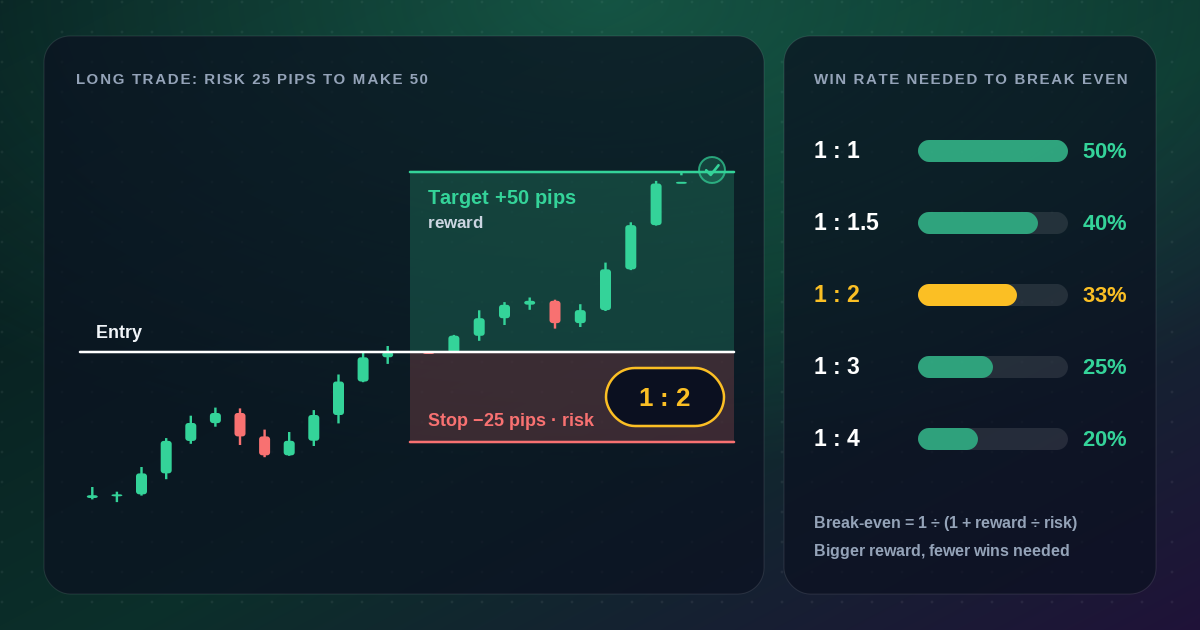
- Risk-reward compares what you stand to lose with what you aim to gain: a 25-pip stop and a 50-pip target is 1:2.
- Break-even win rate = 1 ÷ (1 + reward ÷ risk): 50% at 1:1, 33% at 1:2 and 25% at 1:3.
- Place the stop where the idea is proven wrong, then find a logical target, and skip trades that do not offer at least 1:2.
- Track planned against actual risk-reward in your journal to see whether you exit winners too early.
Mastering the Risk-Reward Ratio
Every trade is a little wager: “I’m willing to lose x to (hopefully) gain y.” The risk-reward ratio (R:R) tells you exactly what that wager looks like-and why two traders can share the same win-rate but see totally different equity curves 📈.
The Equation
Risk-Reward = Potential Loss / Potential Gain
e.g. risking 25 pips for a target of 50 pips gives an R:R of 1 : 2.
Tilt the Math in Your Favour
With a 1 : 2 ratio, you only need to win 33 % of your trades to break even. Bump it to 1 : 3 and the breakeven win-rate drops to 25 %. Suddenly the market doesn’t have to be “right” as often for you to stay profitable.
Psychology Booster
Knowing the potential payoff can be double or triple your risk makes accepting small losses emotionally easier-no more “just one more pip” bargaining.
Breakeven Cheat-Sheet
| Risk-Reward | Needed Win-Rate to Break Even |
|---|---|
| 1 : 1 | 50 % |
| 1 : 1.5 | 40 % |
| 1 : 2 | 33 % |
| 1 : 3 | 25 % |
| 1 : 4 | 20 % |
(Formula: Breakeven% = 1 ÷ (1 + Reward/Risk))
How to Apply R:R in Real Time
- Spot the setup → identify your entry trigger.
- Define invalidation → where is the trade wrong? That’s your stop.
- Project target → logical next support/resistance, measured move, or fib extension.
- Divide reward by risk. If it’s at least 1 : 2, green-light the trade; if not, pass or refine.
Journaling tip: tag every trade in Tracom with its intended R:R and the actual outcome. Over 50+ trades you’ll see whether you exit too soon, hold too long, or hit the sweet spot 🎯.
Frequently asked questions
What is a good risk-reward ratio?
Many traders look for at least 1:2, meaning the target is twice as far as the stop. At that ratio you only need to win about a third of your trades to break even, so a modest win rate can still be profitable.
How do you calculate the risk-reward ratio?
Measure the distance from entry to stop-loss (the risk) and from entry to take-profit (the reward), then compare them. An entry at 1.0950 with a stop at 1.0925 and a target at 1.1000 is 25 pips of risk for 50 pips of reward: 1:2.
Is a high win rate or a high risk-reward ratio better?
Neither decides profitability alone; the combination does. A 70% win rate still loses money if losers are three times bigger than winners, while a 35% win rate can be profitable at 1:3. Expectancy, (win rate × average win) − (loss rate × average loss), captures both.


Put it into practice with Tracom's trade journal, risk calculator and signal record. Free to download.