Central Banks & Monetary Policy
How the Fed, ECB, Bank of Japan and Bank of England set interest rates, why their decisions and forward guidance drive currency trends, and what traders watch at each meeting.
- Lesson 26 of 30
- 3 min read
- Advanced
- Updated


Key takeaways
- Most central banks target price stability, typically 2% inflation, and some, like the Fed, maximum employment as well.
- Their tools include interest rates, quantitative easing or tightening, currency intervention and forward guidance.
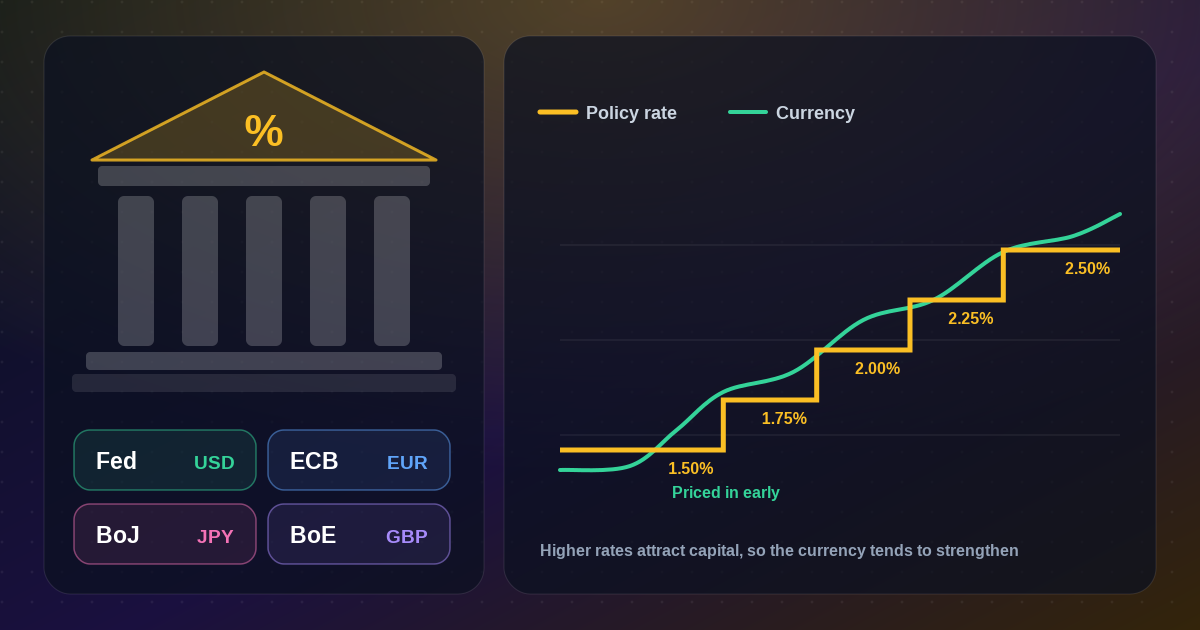
- Higher rates tend to strengthen a currency, but markets move on expectations, often well before a decision.
- The Fed, ECB, Bank of Japan and Bank of England each meet eight times a year, and a change of wording in their statements can move markets.
Central Banks 🚀 –
The Monetary Masters of Forex
Behind every dramatic candle on your EUR/USD chart lurks a central bank decision - a rate hike, a surprise cut, or simply a few choice words in a press conference. Understanding these institutions is like getting the director’s commentary on the movie we call the FX market. 🍿
Their Mandate
Most target price stability (inflation ~2 %) and maximum employment. Hit those, and the currency often gains respect.
Policy Toolbox
- Interest-rate moves (the 💣 headline)
- Quantitative Easing / Tightening
- Foreign-exchange intervention
- Forward guidance (jawboning)
Why Traders Care
Higher rates → capital flows in → currency strengthens (usually).
Looser policy → investors flee yield → currency weakens.
But context matters: markets price the expectation well in advance!
The “Big Four” at a Glance

Federal Reserve (Fed)
Controls the world’s reserve currency (USD). Watch FOMC meetings & the infamous “dot plot”.

European Central Bank (ECB)
Sets rates for the 21 euro-area countries. Speeches from President Lagarde regularly jolt EUR pairs.

Bank of Japan (BoJ)
Kept policy ultra-loose for decades, with negative rates and yield-curve control until 2024. Each step toward normal policy can send USD/JPY flying.

Bank of England (BoE)
Sets rates for the pound. Nine-member MPC loves a good 7-2 split vote-great fodder for GBP volatility.
Typical Meeting Schedule
| Central Bank | Frequency | Key Documents |
|---|---|---|
| Fed (FOMC) | 8× per year | Statement, Dot-Plot, Powell presser |
| ECB | 8× per year | Monetary Policy Statement, Presser |
| BoJ | 8× per year | Policy Statement, Outlook Report |
| BoE (MPC) | 8× per year | Minutes, Monetary Policy Report (quarterly) |
Markets often move before the announcement as traders position for an expected change - then whip around if reality diverges from the rumour mill.
Trader tip: bookmark each bank’s forward guidance paragraph. If it shifts from “we may” to “we will”, brace yourself - that tiny wording tweak can spark a multi-figure move! 🔥
Frequently asked questions
How do interest rates affect currencies?
Higher interest rates make a currency more attractive to hold, drawing in capital and usually strengthening it, while cuts tend to weaken it. Because markets anticipate moves, the surprise relative to expectations matters more than the decision itself.
What is forward guidance?
Forward guidance is what a central bank says about the likely path of future policy. A shift in wording, for example from saying it may raise rates to saying it will, can move a currency as much as an actual rate change.
How often do central banks meet?
The Federal Reserve, European Central Bank, Bank of Japan and Bank of England each hold eight scheduled policy meetings a year. Their calendars are published in advance, so traders can plan around them.


Put it into practice with Tracom's trade journal, risk calculator and signal record. Free to download.