Developing a Strategy
Build a trading strategy from scratch: a market filter, an entry trigger, risk rules and trade management, then test and refine it, with a sample playbook.
- Lesson 19 of 30
- 3 min read
- Intermediate
- Updated


Key takeaways
- A strategy is a repeatable recipe with five parts: market filter, entry trigger, risk rules, trade management and review.
- Write each rule so precisely that a 10-year-old could spot the setup on a chart.
- Example playbook: EUR/USD or GBP/USD on the hourly chart in the London session, 50 EMA rising, buy a bullish engulfing candle at the 38–50% retracement, stop below the swing low, target 2R, risk 1%.
- Backtest on historical data, forward-test on a demo, and filter your journal by strategy to see whether the edge is real.
Crafting Your Edge – Developing a Personal Trading Strategy
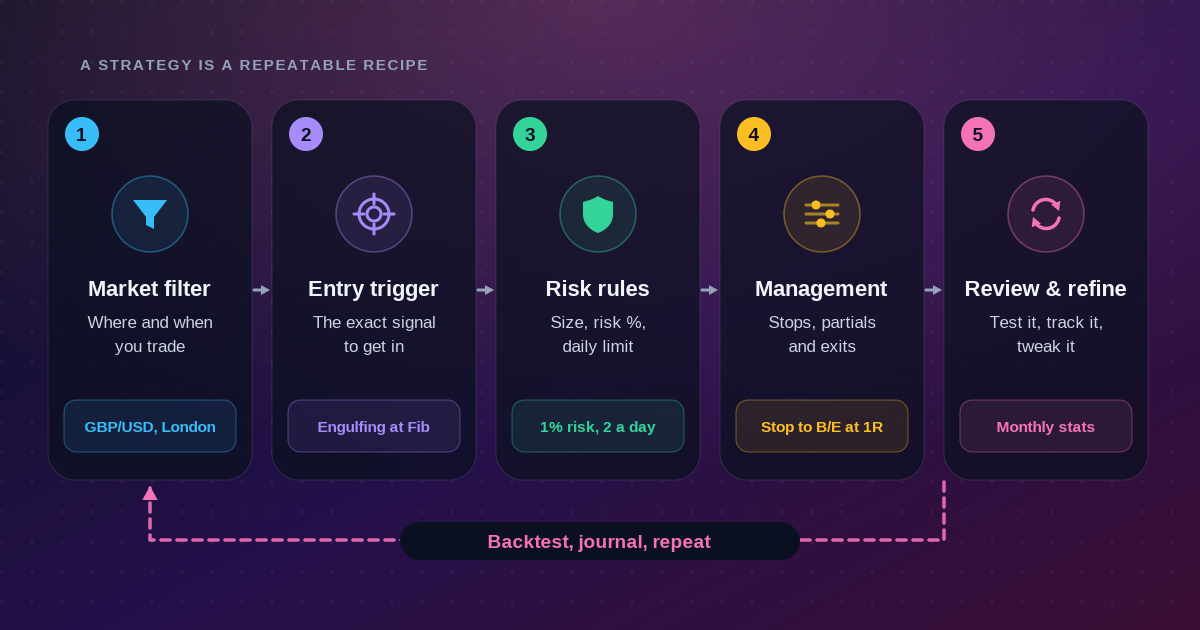
A strategy is simply a repeatable decision-making recipe. Get the ingredients right and you’ll spend less time second-guessing, more time compounding 📈.
1 · Market Filter
Decide where & when you trade: specific pairs, sessions, volatility regimes. E.g., only GBP/USD during London–NY overlap.
2 · Entry Trigger
Candlestick pattern? Moving-average cross? RSI divergence? Whatever it is, write it down so a 10-year-old could spot it.
3 · Risk Rules
Position-size formula, % risk cap, maximum daily drawdown-non-negotiables that keep you in business.
4 · Trade Management
Trail stop? Partial take-profit? Time-based exit? Define it so you’re not improvising under pressure.
5 · Review & Refine
Backtest, forward-test, journal. Monthly stats reveal tweaks-maybe adjust TP to 1.8× SL, or ditch Friday trades.
Sample “Trend-Pullback” Playbook 📚
- Trade only EUR/USD & GBP/USD on the H1 chart during London session.
- 50-EMA slopes up ⟶ bull bias (
market filter). - Price retraces to the 38–50 % Fibonacci of last impulse.
- Wait for bullish engulfing candle at that fib (
entry trigger). - Stop-loss = below swing low; Take-profit = 2× risk.
- Risk 1 % per trade; max two trades per day.
- Move SL to breakeven after +1R (
trade management). - Log screenshot & feelings in Tracom immediately.
Simple? Absolutely. Repeatable? 100 %. That’s the goal.
Pre-Trade Checklist ✅
- Is today a major news day? (Yes → half risk or stand aside.)
- Does price align with my bias on both H1 & H4?
- Entry candle closed? No chasing wicks!
- Correct position size confirmed in calculator?
- Screenshot taken, notes typed?
Pro tip: Every strategy needs a journal buddy. Log each trade in Tracom, then filter by strategy tag to see if your edge is paying rent or just hoarding screen time. 🏠
Frequently asked questions
How do I create my own trading strategy?
Pick a market and session, define one setup and the exact trigger that gets you in, set your stop, target and position-sizing rules, and decide how you will manage the trade. Then backtest it over at least 50 to 100 examples before risking real money.
What is a trend pullback strategy?
It trades in the direction of an established trend after price retraces against it, for example buying an uptrend when price pulls back to the 38–50% Fibonacci zone or a rising moving average and prints a bullish candle.
How do I know if my strategy works?
Measure it. Over a meaningful sample of trades, check the win rate, the average win and loss in R, the expectancy and the maximum drawdown. A positive expectancy that holds up in forward testing is the evidence you need.


Put it into practice with Tracom's trade journal, risk calculator and signal record. Free to download.