Why Risk Management Matters
Why protecting capital beats chasing profits: drawdown maths, the 1–2% rule, risk-reward and the risk management framework that keeps you trading for the long term.
- Lesson 13 of 30
- 3 min read
- Intermediate
- Updated


Key takeaways
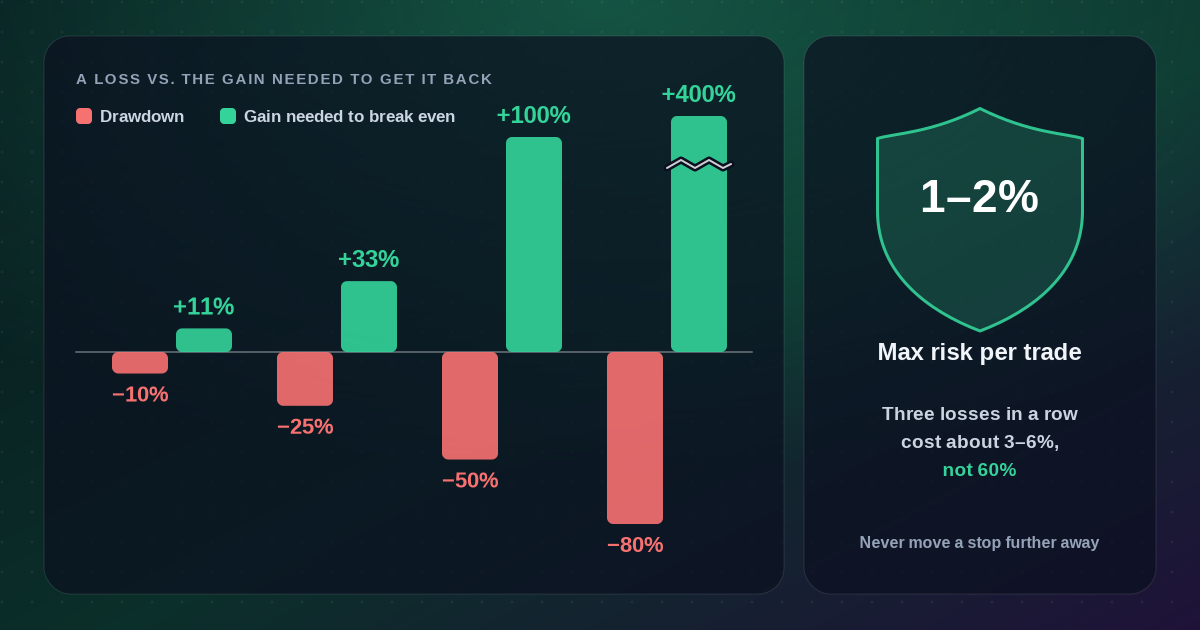
- Losses are asymmetric: a 10% loss needs an 11% gain to recover, a 50% loss needs 100% and an 80% loss needs 400%.
- Most professional traders risk 1–2% of their account per trade, so a run of losses stays small.
- Size each position with (account × risk %) ÷ (stop-loss in pips × pip value).
- Aim for a reward at least twice your risk, and never move a stop-loss further away once a trade is open.
Risk Management: Protect the Downside
In trading, he who survives, wins. 🎯 You can’t control where price goes, but you can control how much a single bad idea hurts. Think of risk management as the seat-belt that lets you drive fast without flying through the windshield.
Why small losses matter
A 10 % loss needs only 11 % to claw back. A 50 % loss? You need a whopping 100 %. The deeper the hole, the steeper the ladder.
| Drawdown | Return Required to Break Even |
|---|---|
| 10 % | 11 % |
| 25 % | 33 % |
| 50 % | 100 % |
| 80 % | 400 % |
1-2 % per Trade, Max
Most pros cap account-level risk at 1 – 2 %. Blow three trades in a row? You’re down ~6 %, not 60 %.
Size via Formula
Position = (Account × Risk %) ÷ (Stop pips × pip value)
Plug into a spreadsheet or Tracom’s calculator and let math do the discipline.
Aim for ≥ 1 : 2 R-R
A 1 : 2 ratio means you can be wrong 50 % of the time and still make money. Bigger edge? Even better.
Never Move a Stop Further
Moving a stop is like cancelling insurance mid-crash. Close, re-assess, re-enter-don’t pray.
Quick Scenario
• Account: $5 000 • Risk: 1 % → $50 • Trade: EUR/USD, 30-pip stop • Pip value (standard lot) ≈ $10
Position size $50 ÷ (30 pips × $10/pip) = 0.17 lots (≈ 17 k units) Set stop, set TP at 60 pips, walk away. 📏✂️
Remember: the goal isn’t homeruns, it’s years of steady growth. Protecting capital today keeps you in the game tomorrow-so compound can weave its magic. ✨
Frequently asked questions
What is the 1% rule in trading?
The 1% rule means never risking more than 1% of your account on a single trade. On a $5,000 account that is $50: the position is sized so that if the stop-loss is hit, the loss is no more than that amount.
How much should I risk per trade?
Most traders cap risk at 1–2% of their account per trade. At 1%, ten losing trades in a row cost about 10%, which is painful but recoverable; at 10% per trade the same streak would wipe out most of the account.
Why is risk management so important in forex?
Because leverage makes it easy to lose a large share of an account quickly, and losses get harder to recover the deeper they go. Consistent position sizing keeps you in the game long enough for a profitable strategy to work.
Put it into practice with Tracom's trade journal, risk calculator and signal record. Free to download.