Building a Trading Plan
Build a complete trading plan covering goals, markets, entry and exit rules, risk limits, a daily checklist and a review routine, with a copy-and-paste plan template.
- Lesson 17 of 30
- 3 min read
- Intermediate
- Updated


Key takeaways
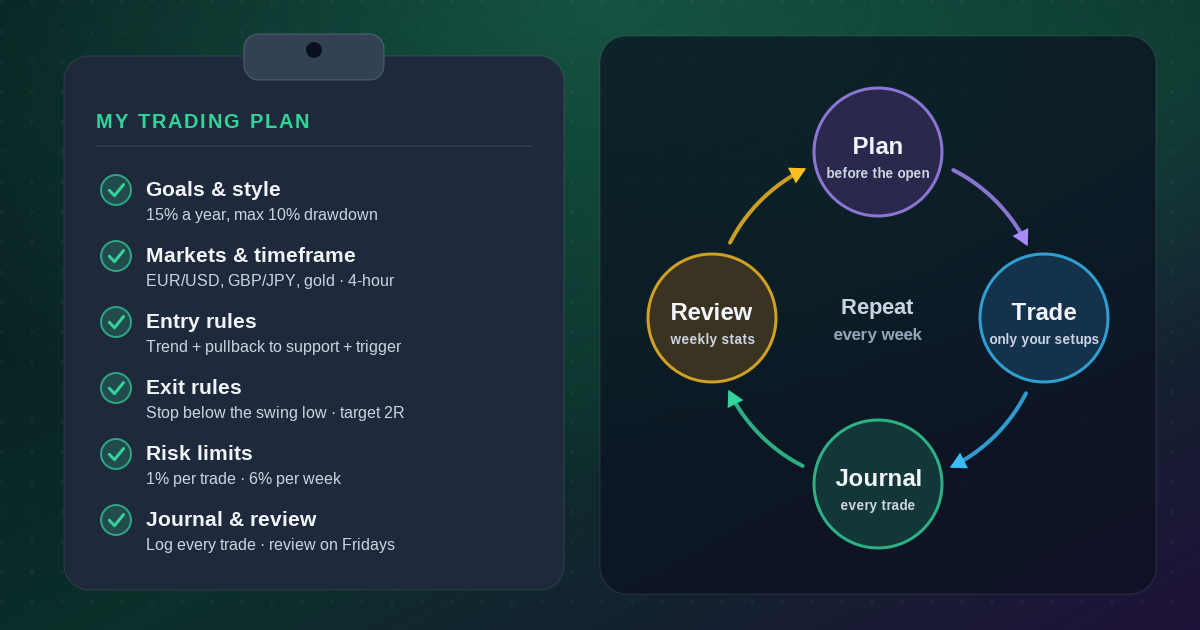
- A trading plan sets your goals, markets, timeframes, entry and exit rules, risk limits and review routine before you trade.
- Write rules precisely enough that someone else could follow them, for example “buy when the 9 EMA crosses above the 21 EMA at support with the RSI above 50”.
- Cap risk per trade (1–2%) and per week (for example 6%), and size every position with the formula.
- Journal every trade and review weekly, changing rules only when the data says so.
Crafting Your Trading Plan
A trading plan is your personal GPS: it tells you where to trade, when to pull the trigger and, crucially, when to get out. No more seat-of-the-pants decisions - everything is scripted before the market opens.
1. Goals & Style
Why are you trading? Supplement income, build retirement, or pure sport? Pin down specific targets: e.g. “15 % return per year with max 10 % drawdown”.
2. Market Universe
Stick to a handful of pairs you know. Example: EUR/USD, GBP/JPY, XAU/USD. Define your chart timeframe (e.g. 4 H for swing, 1 min for scalping).
3. Entry & Exit Criteria
Be unambiguous: “Buy when 9 EMA crosses above 21 EMA and RSI > 50 at a support zone.” Same clarity for exits: TP at 2 R or MA cross-back; SL below last swing-low.
4. Position Sizing & Max Risk
Cap risk at 1 – 2 % of equity per trade, 6 % per week.
Use the formula: (Acct × Risk %) ÷ (SL pips × pip value).
5. Journaling & Review
Log every trade in Tracom 🚀. End of week, tag winners vs. losers, screenshot setups, and adjust rules if stats drift.
Your 7-Step Daily Checklist ✅
- Scan economic calendar 🎯 - avoid red-flag news against open trades.
- Mark support/resistance on chosen pairs.
- Check trend direction on higher timeframe.
- Wait for your entry trigger (no trigger, no trade!).
- Calculate lot size to fit the 1 % rule.
- Place trade ➜ set SL & TP immediately.
- Log trade details in Tracom, including screenshots & emotion rating.
Copy-Paste Plan Skeleton 📝
# My Forex Trading Plan

## 1. Objectives
• 15 % annual return
• Max 10 % drawdown

## 2. Markets
• EUR/USD, GBP/JPY, XAU/USD
• 4 H swing trades

## 3. Entry Rules
• Bullish trend (50 MA ↑)
• Price at 38 % Fib retrace
• Bullish pin bar
• RSI > 50

## 4. Exit Rules
• TP = 2 × risk (2 R)
• SL = below setup low

## 5. Risk
• 1 % per trade
• 3 concurrent trades max

## 6. Routine
• London open analysis 07:30 GMT
• Review closed trades Friday 18:00 GMT

## 7. Mindset
• Accept SL as tuition, not failure
• No phone trades after 22:00
Frequently asked questions
What should a trading plan include?
At minimum: your goals and trading style, the markets and timeframes you trade, precise entry and exit rules, risk limits per trade and per week, a daily routine, and how you will journal and review your trades.
Why do traders need a trading plan?
A plan makes decisions in advance, while you are calm, instead of in the moment, when fear and greed are loudest. It also gives you something to measure: you can only improve rules you have written down.
How often should I review my trading plan?
Review your trades weekly and the plan itself monthly or quarterly. Change a rule only when enough trades, ideally 30 or more, show a clear pattern, not after one painful loss.
Put it into practice with Tracom's trade journal, risk calculator and daily signals. Free to download.