Trading Styles
Compare scalping, day trading, swing trading and position trading by holding time, chart timeframe and screen time to find the style that fits your schedule and personality.
- Lesson 18 of 30
- 3 min read
- Intermediate
- Updated


Key takeaways
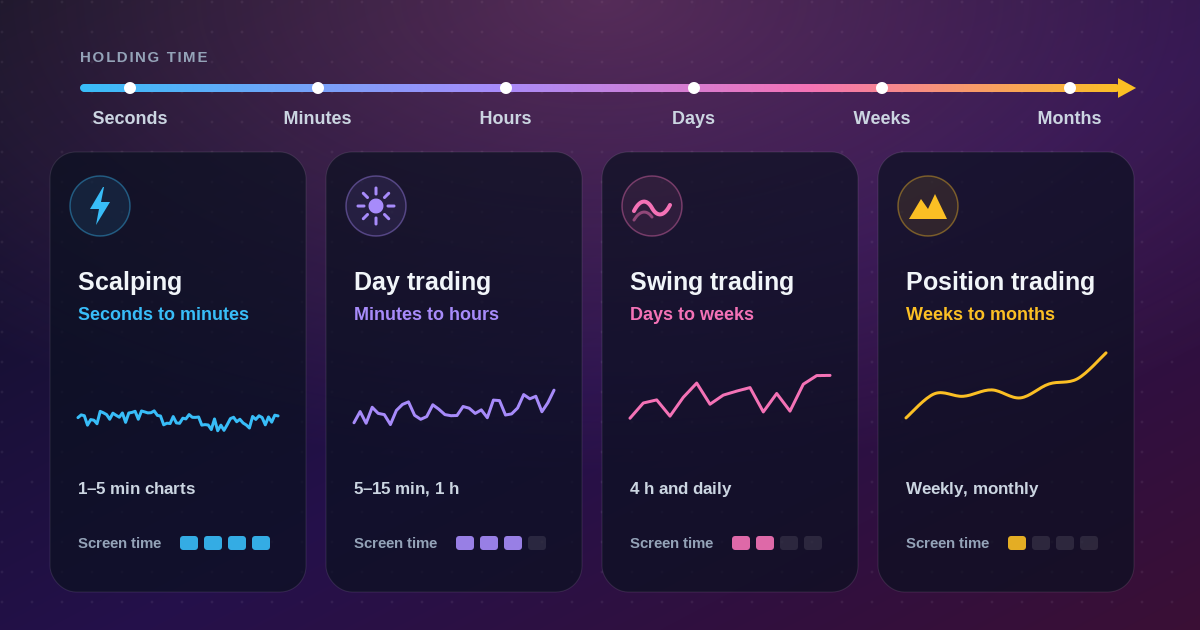
- Scalpers hold for seconds to minutes on 1–5 minute charts, where spreads and fast execution matter most.
- Day traders open and close positions within the day, usually on 5–15 minute and hourly charts, with nothing held overnight.
- Swing traders hold for days to weeks on 4-hour and daily charts and need far less screen time.
- Position traders hold for weeks to months based on macro trends and rate cycles, accepting wide stops and overnight swap costs.
Pick Your Trading Style
Are you the quick-draw type who loves fast action, or the patient strategist who plants a trade and lets it bloom? Trading style is really about matching the market’s rhythm to your personality, schedule and risk appetite. Let’s meet the main characters. 👇
Scalping ⚡
In-and-out in minutes, hunting tiny moves (5–15 pips) with razor-thin spreads. You’ll need lightning execution, low latency-and strong coffee!
- Typical chart: 1-min
- Pros: many opportunities
- Cons: spread/fees matter
Day Trading ☀️
All trades opened and closed the same day-no overnight swaps, no bedtime stress. Perfect if you can watch charts for a few hours but still want evening freedom.
- Typical chart: 5–15 min
- Pros: clear daily routine
- Cons: requires screen time
Swing Trading 🌊
Ride the “swings” within a trend for days or weeks. Fewer trades, bigger targets-great for people with day jobs or who hate staring at ticks.
- Typical chart: 4 h – Daily
- Pros: less screen time
- Cons: hold through news gaps
Position Trading 🏔️
The marathon approach-hold for months based on macro trends and rate cycles. Swap costs and patience required, but potential for mega moves.
- Typical chart: Weekly
- Pros: minimal screen time
- Cons: wide stops, large swings
Quick Comparison
| Style | Hold Time | Core Charts | Key Focus |
|---|---|---|---|
| Scalping | Seconds – Minutes | 1–5 min | Spread, latency, momentum bursts |
| Day | Minutes – Hours | 5–15 min / 1 h | Session ranges, news catalysts |
| Swing | Days – Weeks | 4 h / Daily | Market structure, pullbacks |
| Position | Weeks – Months | Weekly / Monthly | Fundamentals, rate cycles |
Rule of thumb: the shorter the timeframe, the more trades-and the tighter the risk controls required.
Try this: open your Tracom journal and jot down your daily availability, stress tolerance and decision speed. Which style ticks those boxes? Start there and evolve as you grow. 🚀
Frequently asked questions
Which trading style is best for beginners?
Swing trading on 4-hour and daily charts suits many beginners: decisions are slower, there is less noise and it fits around a job. Scalping is the hardest place to start, because costs and execution speed matter so much.
What is the difference between swing trading and day trading?
Day traders close every position before the end of the day and work from short timeframes. Swing traders hold for several days or weeks to capture larger moves within a trend, using 4-hour and daily charts.
Can I trade forex part-time?
Yes. Swing and position trading need only a short session each day to review charts and manage orders. Set price alerts and pending orders so the market comes to you.


Put it into practice with Tracom's trade journal, risk calculator and signal record. Free to download.