Position Sizing & Risk Per Trade
Calculate the right position size for every trade from your account balance, risk percentage and stop-loss distance, with worked examples and a quick reference table.
- Lesson 14 of 30
- 3 min read
- Intermediate
- Updated


Key takeaways
- Position size = (account × risk %) ÷ (stop-loss in pips × pip value per lot).
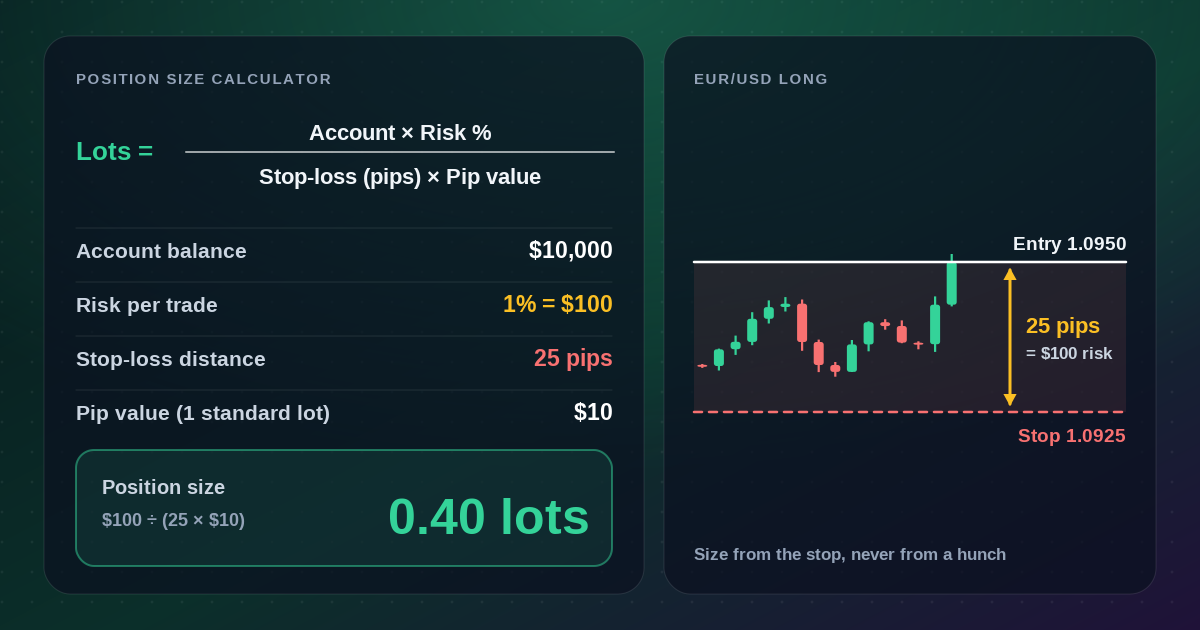
- Example: $10,000 × 1% = $100, and $100 ÷ (25 pips × $10) = 0.40 standard lots.
- A wider stop means a smaller position, so the money at risk stays the same whatever the setup.
- Pip values differ between pairs, so recalculate for every trade instead of using a fixed lot size.
Position Sizing: How Much Should I Trade?
Ever clicked Buy and then realised you had no idea how many lots you just opened?
Let’s fix that! Position sizing is your seat-belt-it keeps risk at a comfortable level so one bad trade
never wipes you out.
The 1-Line Formula
Risk per trade (in $) divided by stop-loss pips × pip value tells you how many lots to trade.
Position size = (Account × Risk%) ÷ (Stop-loss pips × Pip value)Keep risk ≤ 2 % of your account (many pros cap at 1 %).
Example Setup
- Account equity: $10 000
- Risk per trade: 1 % ($100)
- Pair:
EUR/USD - Stop-loss: 25 pips
- Pip value (std lot): $10
Calculation
Lots = 100 $ ÷ (25 pips × 10 $/pip)
     = 0.40 lots
So you’d open 0.4 standard lots (40 k units) to keep risk at $100.
Quick-Look Table (EUR/USD, 10 $ per pip)
| Account | Risk % | Stop pips | Lots |
|---|---|---|---|
| $5 000 | 1 % | 30 | 0.17 |
| $10 000 | 2 % | 50 | 0.40 |
| $25 000 | 1 % | 20 | 1.25 |
Assumes pip value = $10 (standard lot) – adjust for minis/micros.
3 Sneaky Pitfalls to Avoid
- Flat lot size every trade (risk changes when stop size changes).
- Ignoring pair differences – pip value on GBP/JPY ≠ EUR/USD.
- Re-entering bigger after a loser (“revenge sizing”).
Remember: Size slowly grows with account equity. Nail consistency first, then compounding does the heavy lifting. 📈
Frequently asked questions
How do I calculate my lot size?
Decide how much you will risk (for example 1% of a $10,000 account, or $100), measure your stop-loss in pips (say 25) and find the pip value per lot ($10 for a standard lot of EUR/USD). Then divide: $100 ÷ (25 × $10) = 0.40 lots.
Should I use the same lot size on every trade?
No. With a fixed lot size, your risk changes every time your stop distance changes. Sizing from the stop keeps the amount at risk constant: a 50-pip stop gets half the position of a 25-pip stop.
Does position size change between currency pairs?
Yes, because pip values differ. A pip on a standard lot of EUR/USD is worth $10, but on GBP/JPY it depends on the yen exchange rate. Tracom’s calculator handles the conversion for any pair and account currency.


Put it into practice with Tracom's trade journal, risk calculator and signal record. Free to download.