Discipline & Consistency
The habits, routines and accountability that separate consistent traders from impulsive ones: following the plan, a daily routine and walk-away rules.
- Lesson 22 of 30
- 3 min read
- Intermediate
- Updated


Key takeaways
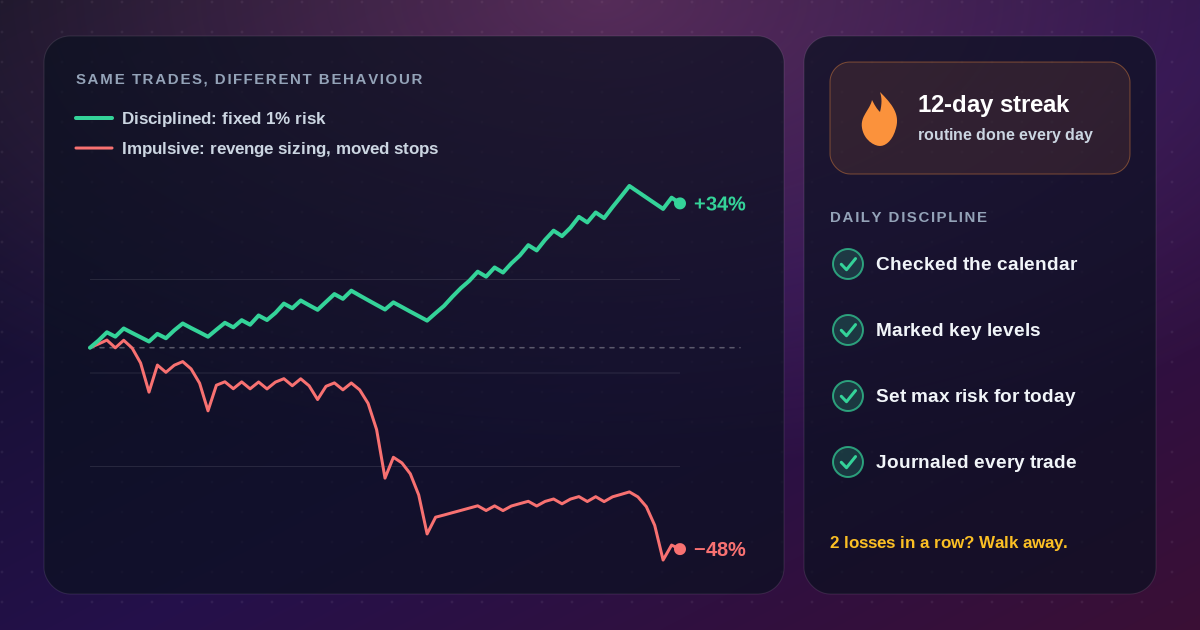
- Your behaviour is the one variable you control; discipline lets a strategy’s edge play out over many trades.
- Follow a written plan covering entries, risk, trade management and exits, and never add to losing positions.
- Treat trading like training: a fixed routine, a pre-session scan and a review afterwards.
- Set a walk-away rule, such as stopping for the day after two losses in a row, and use a calculator instead of mental maths.
Discipline & Consistency – Your Real Edge
Markets change. Spreads widen. News shocks hit. The one variable you can always control is your behaviour. Discipline keeps you alive long enough for the math of your strategy to do its job.
Follow the Plan
If your idea of a plan is a sticky-note saying “buy the dip”, you’re in trouble. A real plan covers entry trigger, risk %, trade management and exit criteria.
- Pre-define all scenarios (win, breakeven, loss).
- Never add to losers; you’re not “improving price”-you’re inflating risk.
Routine & Environment
Treat trading like a gym session: warm-up, execute, cool-down. A tidy workspace and a fixed daily slot beat “whenever I feel like it”.
- 5-minute market scan → note key levels.
- Stretch/walk on long screens-fresh eyes reduce tunnel vision.
Emotional Circuit-Breaker
Fear of missing out (FOMO) and revenge trades are account killers. Define a “walk-away” rule: e.g., 2 consecutive losses = shut platform for the day.
- Use position-sizing calculators-remove on-the-fly math (aka panic).
- Set platform alerts; chasing screens is optional, sanity is not.
Daily Discipline Checklist ✅
- Reviewed economic calendar & potential “landmines”.
- Logged yesterday’s trades in Tracom & reflected on improvements.
- Defined max risk for the day (e.g., 3R or 2 % of equity).
- Visualised key levels & scenarios for each watch-list pair.
Journal prompt: After today’s session, jot down one disciplined action you’re proud of and one slip-up you’ll correct tomorrow. Tiny tweaks = compound growth. 📈
Frequently asked questions
How do I become a more disciplined trader?
Write a plan, follow a daily routine and make your rules automatic: set stops and targets as you enter, use a position size calculator, and stop trading after a set number of losses. Journal whether each trade followed the plan.
Why is consistency important in trading?
A strategy’s edge only shows up across many trades. If you change rules, size or setups from one trade to the next, your results become random and you cannot tell what works.
What is a good daily trading routine?
Check the economic calendar, mark key levels on your pairs, set your maximum risk for the day, trade only your setups, then journal and review. Tracom turns these steps into a daily routine with streaks and XP.
Put it into practice with Tracom's trade journal, risk calculator and signal record. Free to download.